
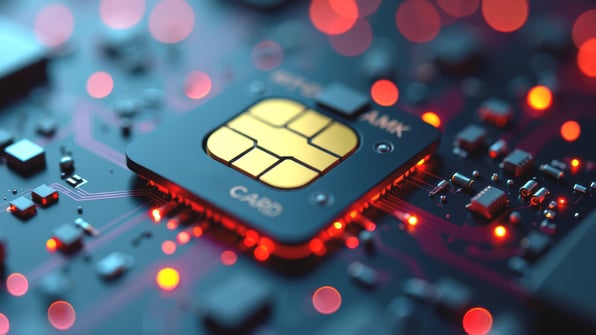
iSIM, The Next Evolution of Secure Connectivity for IoT
For over 20 years, the telecommunications industry has chased a singular goal: making connectivity invisible. We have transitioned from the oversized credit-card-style SIMs of the 1990s to the fingernail-sized Nano SIMs, and eventually to the soldered eSIMs that power today’s leading smartphones and industrial sensors.
But for the Internet of Things (IoT) to reach its true potential—what we call "Massive IoT"—even the eSIM has its limitations. As device manufacturers face increasing pressure to reduce costs, extend battery life, and shrink hardware footprints, the industry is shifting towards a more efficient paradigm: the Integrated SIM (iSIM).
Defining the iSIM
Unlike traditional SIM cards or even embedded SIMs (eUICC), iSIM functionality is integrated directly into a device’s main System-on-Chip (SoC). By embedding the SIM functionality—including secure key storage and network authentication—into the same silicon that houses the modem or main processor, iSIM eliminates the need for separate hardware.
This isn't just a minor technical tweak; it is a fundamental shift in how we design, manufacture, and secure connected devices. According to GSMA Intelligence, cellular IoT connections are projected to reach 6.5 billion globally by 2030. To manage that scale, the industry requires the efficiency that only integration can provide.
How iSIM Differs From eSIM
Understanding the transition requires a look at how the hardware itself has changed. The following table highlights why iSIM is becoming the preferred choice for mass-scale deployments compared to its predecessors.
|
Feature |
Traditional SIM |
eSIM (eUICC) |
iSIM |
|
Physical Presence |
Removable plastic card |
Dedicated embedded chip |
Integrated into SoC |
|
Hardware Footprint |
Large (requires slot) |
Smaller (approx. 5x5mm) |
Minimal (Integrated) |
|
Power Consumption |
Higher |
Lower |
Lowest |
|
Manufacturing Cost |
Higher (BOM + Logistics) |
Reduced |
Significantly reduced |
|
Security Architecture |
Isolated |
Secure Element-based |
Fully integrated secure environment |
|
Best For |
Legacy devices |
Modern IoT & Consumer |
Mass IoT & Ultra-compact |
Technical Architecture and Security
The iSIM operates within a secure execution environment inside the device's main SoC. This architecture relies on an Integrated Secure Element (TRE) that provides hardware-level protection for keys and credentials.
By implementing GSMA-compliant remote SIM provisioning (specifically the SGP.32 standard for IoT), the integrated eUICC functionality manages operator profiles without a physical interface. This connectivity stack interfaces directly with the modem, supporting everything from 5G and LTE-M to NB-IoT. This setup allows for "zero-touch" provisioning, enabling devices to be shipped globally and localized over-the-air.
Why iSIM Matters for Scale
The shift to iSIM is a business necessity for the next generation of connected infrastructure. Juniper Research anticipates that the market for eSIMs and iSIMs will see over 250% growth in connected devices by 2030.
This momentum is driven by several transformational benefits:
- Reduced Cost: Eliminating the external SIM or eSIM chip reduces the bill-of-materials (BOM) cost and simplifies supply chain logistics.
- Lower Power Consumption: Because iSIM is part of the main processor, it reduces energy required for component communication, extending the battery life of remote sensors to over a decade.
- Space Savings: An iSIM occupies a fraction of the space of even an eSIM, enabling form factors like smart labels and ultra-compact medical wearables.
- Improved Security: Security is enforced at the silicon level. With no physical chip to tamper with or remove, the attack surface is effectively reduced.
Industry Use Cases
The benefits of iSIM are particularly transformative in "constrained" environments. In Smart Metering, utility providers can deploy millions of devices that operate in harsh conditions with zero maintenance. In Logistics, iSIM enables ultra-low-cost, globally deployable trackers for "smart labels."
In Healthcare, smaller and more power-efficient wearables can stay always-connected without the bulk of traditional hardware.
Future Outlook
The momentum behind iSIM is undeniable. As 5G RedCap (Reduced Capacity) and NB-IoT continue to mature, iSIM will provide the foundational connectivity that allows these networks to scale. For organizations planning future IoT deployments, iSIM is not just an evolution—it is the foundation for truly scalable, secure, and cost-efficient global IoT connectivity.
Frequently Asked Questions (FAQ)
-
What is the main difference between eSIM and iSIM?
An eSIM is a dedicated chip soldered onto a device's circuit board, whereas an iSIM is integrated directly into the device's main processor (SoC). This integration makes iSIM smaller, more power-efficient, and cheaper to manufacture.
-
Is iSIM as secure as a traditional SIM card?
Yes. iSIM is designed with a hardware-level Secure Element (TRE) inside the processor. This provides a tamper-resistant environment for credentials that is equivalent to or more secure than traditional physical SIM cards.
-
Can iSIM be used with existing cellular networks?
Yes. iSIM follows GSMA standards and is compatible with 2G, 3G, 4G, 5G, LTE-M, and NB-IoT networks, provided the device modem supports those frequencies.
-
How is an iSIM activated or changed to a new carrier? i
SIM uses GSMA-compliant Remote SIM Provisioning (RSP). This allows operator profiles to be downloaded and changed over-the-air (OTA) using a management platform, eliminating the need for physical SIM swaps.
-
Which industries benefit most from iSIM technology?
While applicable to all cellular IoT, industries requiring mass deployment, ultra-compact designs, or extreme battery life benefit most. This includes smart utilities, global logistics (asset tracking), and connected medical wearables.